
A good acorn year comes around unevenly. Some autumns the ground beneath a mature pedunculate oak is carpeted with them; others you will scrabble through damp leaf litter for twenty minutes and come away with a dozen. If you strike lucky, it is worth filling a bag and turning your haul into young trees. The method is simple — collect, test, stratify, sow — but each step has a detail that separates a tray of sturdy seedlings from a sad row of hollow husks.
When and where to gather acorns
In Britain the native oaks are the pedunculate oak (Quercus robur) and the sessile oak (Quercus petraea). Both ripen their acorns in a single season, and both are worth collecting. Telling them apart is a nice excuse for a slow walk: pedunculate oak carries its acorns on long, slender stalks and its leaves sit almost directly on the twig, while sessile oak holds acorns tight against the branch and gives its leaves proper stalks. They cross-breed freely, so plenty of trees sit somewhere in between.
Timing matters more than most people expect. Acorns here generally ripen from mid-September into October, occasionally later in the north or after a mild, wet summer. They are ready when they turn from green to a warm brown and the cups loosen, often after a windy night when the ground is suddenly busy. Collect from trees with healthy, full crowns and no sign of dieback, and look for acorns that are brown, plump and heavy in the hand.
Collecting without stripping the wood
Gather from the ground wherever you can. Acorns picked straight from the branch are often under-ripe and will not store well. Ground collecting also means you take only what has fallen, which is the polite way to do it.
A few rules keep the harvest sustainable and legal. Take only from trees with a real crop, and leave the majority on the ground — jays, squirrels, mice, voles and deer rely on that autumn food, and the jays in particular are among the best oak planters we have. Get the landowner's permission before collecting on private ground, and check the rules of nature reserves and Sites of Special Scientific Interest, where seed collection is often restricted. If you are gathering from a wood you visit often, take a few dozen rather than a bucketful.
Keep acorns from each tree in separate bags, labelled with the date and a note of the location. If one batch rots or fails to germinate, you will know which tree to blame. Your hands will stain brown with tannins, so gardening gloves earn their place.
Checking for weevil damage and running the float test
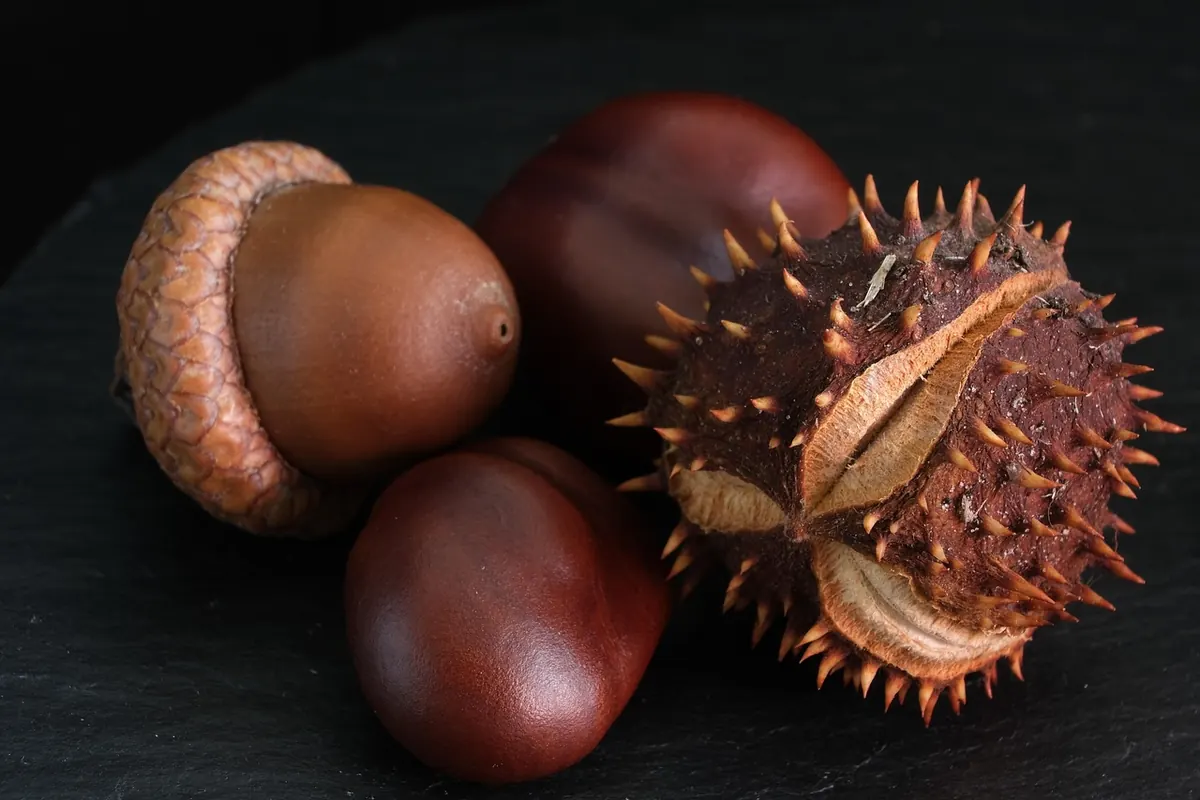
The acorn weevil is the main reason a promising haul ends up worthless. A female drills into the developing acorn and lays an egg inside; the grub then eats the kernel and chews a neat round exit hole, roughly two to three millimetres across, before dropping to the soil to pupate. An acorn with a clean hole near its base is almost certainly empty. You will also find dark, sunken patches and small puncture marks, and those are best discarded too.
The float test is the quick way to sort a pile. Drop the acorns into a bowl of water. Sound acorns generally sink; the light, dried-out and grub-damaged ones float. There is one important caveat: very fresh acorns sometimes float for a while because of air trapped inside, so leave them for fifteen minutes, give them a stir, and then judge. However they behave, cut open a sample of each batch to check. A healthy kernel is pale cream and firm, with no tunnels or dark staining.
Work through the job on the day you collect, not the following weekend. Acorns sweat in a warm bag and mould spreads quickly.
- Discard anything with a round exit hole, usually near the base
- Discard soft, mouldy or shrivelled acorns, and any with dark sunken patches
- Discard persistent floaters, but cut one open first to confirm your instincts
- Cut-test a handful from every batch; a clean, creamy kernel is what you want
- Rinse the keepers and pat them dry — damp is fine, dripping is not
Cold stratification: giving your acorns a winter
Acorns are recalcitrant seeds, which is a technical way of saying they die if they dry out. They also need a period of cold and damp before they will germinate. Around eight to twelve weeks at roughly 1–5°C does the job nicely, and a fridge salad drawer is ideal.
- Mix the acorns with a handful of damp vermiculite, coir or sieved leaf mould. It should hold together when squeezed without releasing water.
- Seal the mix in a labelled freezer bag with a few pinpricks for air, or a lidded tub set slightly ajar.
- Store in the fridge, away from fruit, which releases ripening gas and speeds decay.
- Check every fortnight. Remove anything soft, blue-green with mould, or smelling sour.
- If a small white root appears, pot that acorn up straight away and keep it somewhere cool and light. Do not wait for spring — that root is the beginning of a long taproot and it will not sit patiently.
If your fridge is already full, autumn sowing in a seedbed works well, letting the weather do the stratifying. The trade-off is that mice, voles and squirrels will take their share, so use a deep frame with fine mesh over the top.
Sowing in spring and growing on
Give each acorn a deep pot: a two-litre drinks carton with drainage holes punched in the base, or a proper root trainer, is far better than a shallow tray. Oak roots run straight down and resent being moved. Use multi-purpose compost cut with a quarter to a third grit or sharp sand for drainage.
Sow the acorn on its side, about its own depth below the surface, and water it in. Stand the pots outside in a sheltered spot and cover them with mesh or a cloche to keep rodents off. Once the shoot appears — usually a few weeks after the root has gone down — keep the compost damp through the first summer. Grow your seedlings on for a year or two, until they are somewhere between 30cm and 60cm tall, then plant them out between November and March with a mulch, a stake if the site is exposed, and a guard against rabbits and deer.
Plant them where they have room. An oak is a two-hundred-year commitment and needs light and space above and below ground, so keep it well clear of drains, foundations and overhead cables.
A long game worth playing
Plant more than you need and give the spares to neighbours, a school or a local wood. Expect losses: a dry spring, a hungry deer or a careless strimmer will claim some. And be patient. A young oak will not produce a serious crop of its own for decades, so what you are really doing is leaving something for whoever comes next.
A note on the acorns themselves: they are bitter with tannins and not something to eat raw, and they should not be fed to livestock or pets without proper advice. Collect enough for your pots, leave the rest under the tree, and let the jays plant the thousands you cannot carry.
Photo: wunschbildberlin / Pixabay