
Ancient Woodland Indicators: A 15-Point Checklist for Spotting a Wood That Has Never Been Cleared
Two woods a mile apart can look almost identical from the gate: same oak canopy, same bramble tangle, same muddy ride. One was planted on a field in the 1970s. The other has been wooded since before the Tudor enclosures. The difference rarely announces itself. You have to read the site in layers — the ground flora first, then the shape and age of the trees, then the bumps and hollows in the soil beneath your boots.
What "ancient" actually means
In Britain, ancient woodland is generally defined as land that has been continuously wooded since around 1600 (1750 in Scotland). That date is a documentary convenience rather than an ecological one, but it marks the point from which decent maps and records survive. A wood that has never been cleared is not a pristine wilderness: most ancient woods have been coppiced, pollarded, grazed and cut for timber for centuries. Continuity of woodland cover is the thing that matters, not continuity of individual trees.
The Ancient Woodland Inventory maps these sites, and it is a sensible starting point. Treat it as a guide rather than a verdict: boundaries are often approximate, and plenty of woods were planted with conifers in the twentieth century while the ancient ground flora survived beneath. Those plantations on ancient woodland sites can still be ancient in every way that counts ecologically. The Inventory also misses some genuine ancient woods, especially small copses and wood-pasture sites, so field evidence always deserves a hearing.
Start with the ground flora
Some woodland plants spread very slowly. They creep by rhizomes, or their seed falls close to the parent and rarely travels far. Over centuries they build up into large, continuous colonies. That is what makes them useful: a big patch of dog's mercury or a drift of wood anemone is an accumulation, not an accident. A single plant might be a stray; a carpet is a history.
Look for dog's mercury, wood anemone, ramsons (wild garlic), woodruff, wood sorrel, herb Paris, Solomon's seal, native yellow archangel, wood melick, wood fescue and thin-spiked wood sedge. In the east, oxlip is a strong clue; in the west and north the lists change. County Wildlife Trusts and local record centres publish regional indicator lists, and they are worth carrying in a pocket. Learn the commoner indicators first, because they are the ones you will actually meet.
Useful, but not decisive
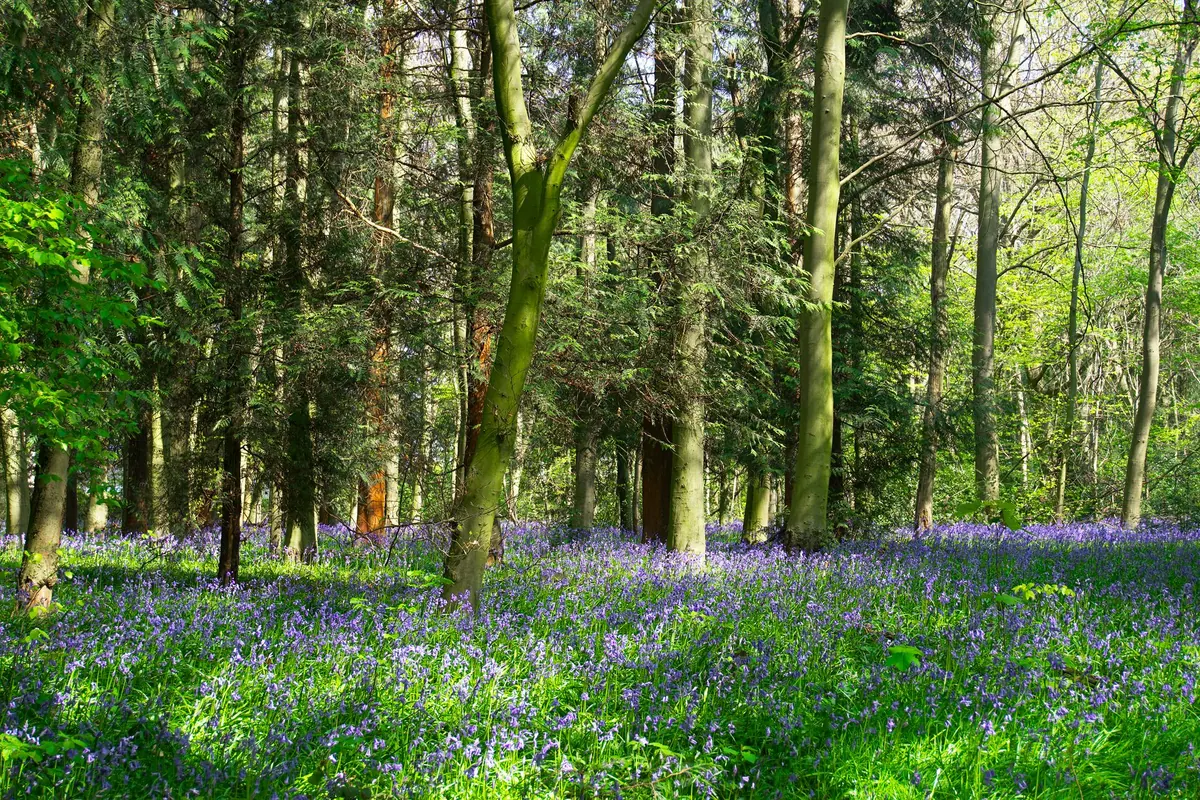
Bluebells are the most quoted indicator and one of the least reliable — they are widely planted and naturalise readily. The same goes for lesser celandine, primrose, foxglove and wood avens, all of which grow happily in hedgerows, gardens and young plantations. A single clump proves nothing. Abundance, continuity across the site and the company a plant keeps are what matter.
Read the wood backwards, too. Large beds of nettle, cleavers and other nutrient-loving plants usually point to enrichment — old pig runs, dumped soil, fertilizer drift from neighbouring fields, or a history of heavy grazing. That does not automatically disqualify a wood from being ancient, but it does mean the ground flora has been disturbed. Ancient woods can be scruffy and nutrient-rich around their edges; the tell-tale communities tend to survive deeper in, along old boundaries, and on banks that were never ploughed.
Look at the trees and their shapes
Individual trees die; the wood persists. So the oldest clues are often not the biggest oaks but the repeated patterns of human use. Coppice stools — the swollen, multi-stemmed bases of trees cut on a cycle — can be centuries old. Some are massive, with a ring of trunks around a decaying centre. Pollards, cut high above the reach of grazing animals, develop fat, gnarly heads and hollow trunks. A line of ancient pollards along a boundary is a strong hint of long-standing wood-pasture.
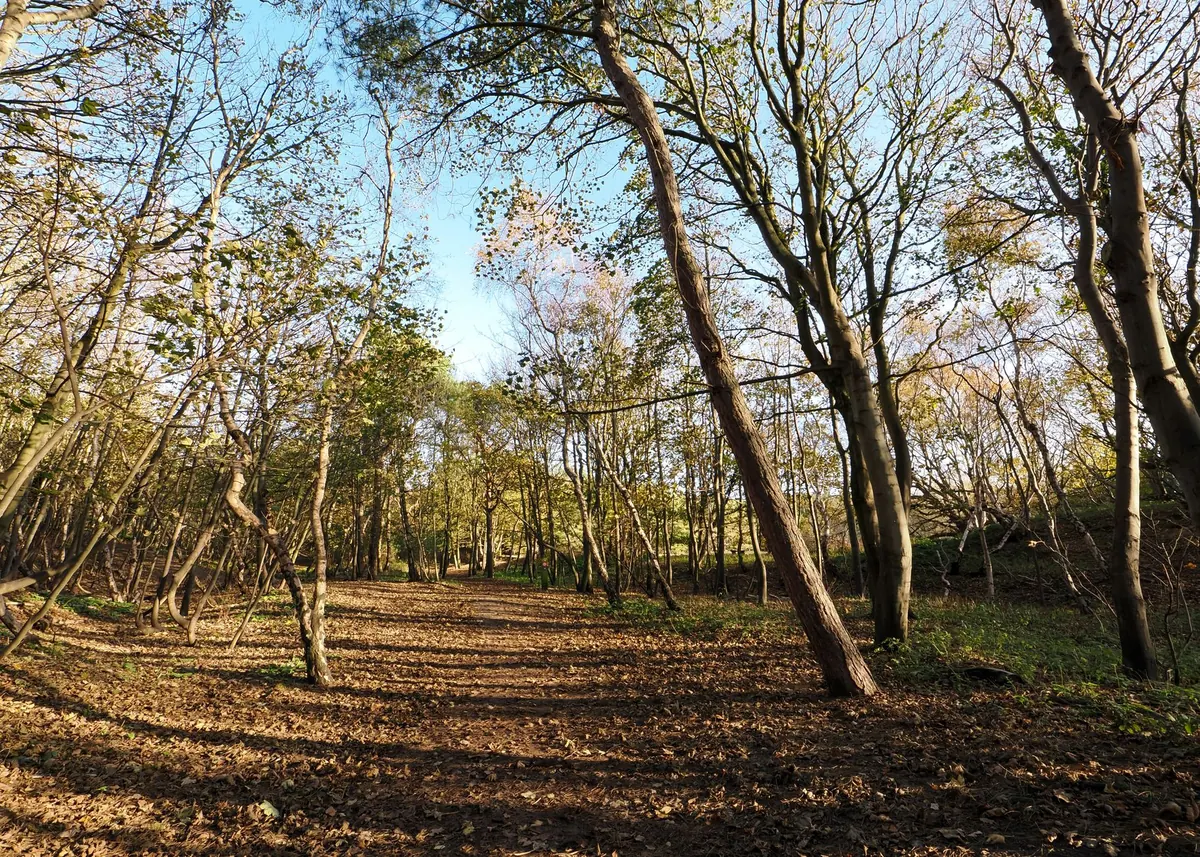
Also look for multi-stemmed trees that are not obviously coppice, old layering where branches have rooted, and a general unevenness of age. Plantations tend to be uniform: same species, same spacing, same age. Ancient woods are messy. They have gaps, deadwood, veteran trees, and a mix of shade and light that has developed over centuries rather than decades.
Read the ground beneath your boots
The soil remembers. Ancient woodland often has a lumpy, hummocky surface: old coppice mounds, boundary banks and ditches, saw pits, charcoal hearths, quarry scoops and the hollows left by long-vanished trees. These earthworks can survive for centuries, especially on clay or chalk. A straight, sharp-edged bank might be a medieval woodbank; a circular platform might be a charcoal hearth; a rectangular depression might be a saw pit. None of them are proof on their own, but together they show a wood that has been worked and lived in for a very long time.
Old boundaries matter too. A woodbank with a ditch on the outside, topped by ancient coppice stools or pollards, is one of the classic signatures of an ancient wood. Hedges along the boundary may contain indicator species such as spindle, dogwood, wild service tree or midland hawthorn. If the wood is on a slope, look for lynchets or old trackways that predate the trees.
The 15-point checklist
Use this as a prompt, not a scorecard. One or two hits mean little; a cluster of them is compelling.
- Large, continuous colonies of slow-spreading plants such as dog's mercury, wood anemone or ramsons.
- Regional indicator species present in abundance, not just one or two individuals.
- Ancient coppice stools — multi-stemmed trees with old, swollen bases.
- Veteran pollards with hollow trunks and heavy, gnarled heads.
- Woodbanks and ditches along the boundary, especially with coppice stools on top.
- Hummocky, uneven ground with old pits, mounds or platforms.
- Deadwood in quantity — standing dead trees, fallen logs, stumps in various stages of decay.
- A mix of ages and species, rather than uniform plantation spacing.
- Old boundary hedges containing indicator shrubs such as spindle, dogwood or wild service tree.
- Rides and glades that follow old earthworks or property lines rather than modern straight lines.
- Woodland mosses and liverworts typical of long-undisturbed shade, especially on old trees and banks.
- Fungi associated with old woodland, such as oak polypore or bearded tooth, though these are seasonal and hard to rely on.
- Historical map evidence showing wood on the same site on estate maps, tithe maps or early Ordnance Survey sheets.
- Place-name clues — names ending in -hurst, -holt, -shaw or -coed can hint at old woodland.
- Absence of obvious plough lines, ridge-and-furrow or planted rows across the site.
Put
Photo: Mike Bird / Pexels